
Where PAGCOR’s gaming money went in 2026: the ₱5.67B dividend, 125 school buildings and ₱60M in scholarships
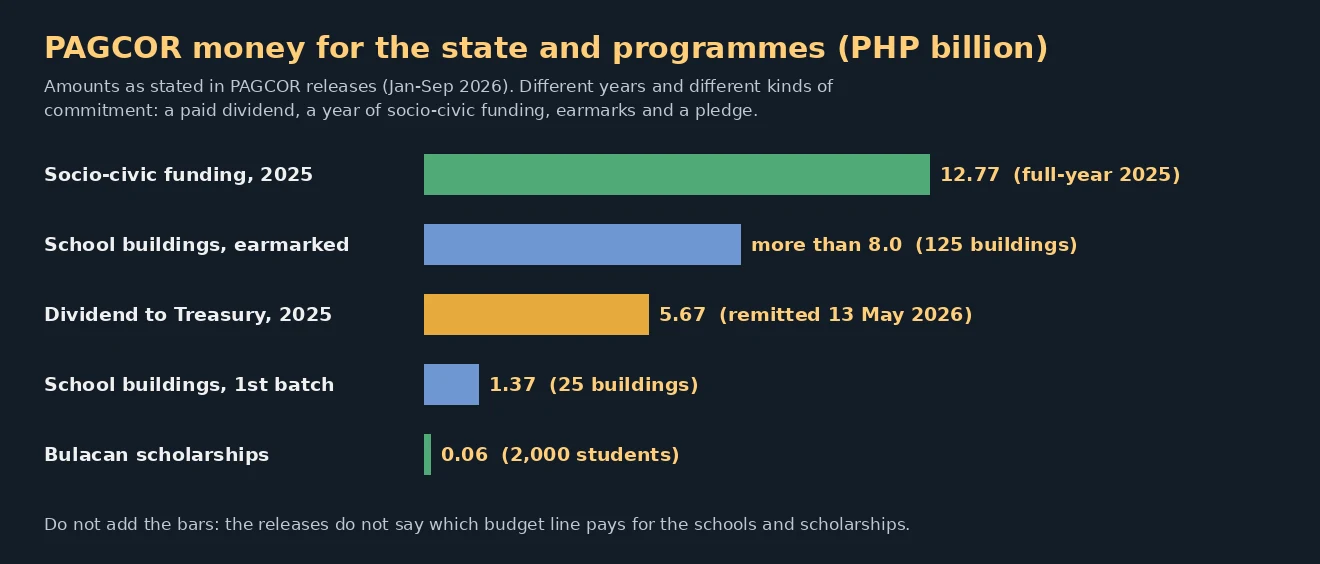
Short answer — Between May and September 2026, PAGCOR announced three ways its gaming income reaches the public. It remitted ₱5.67 billion in dividends to the National Treasury on 13 May, and on 8 July President Marcos Jr. recognised it as the fifth-largest dividend contributor among 50 GOCCs. It is building 125 public school buildings, about 1,500 classrooms, with more than ₱8 billion earmarked, and on 24 September it signed agreements with 66 more LGUs. And it committed ₱60 million to scholarships for 2,000 students in Bulacan. By our calculation, the dividend was 3.85% of the ₱147.15 billion all 50 GOCCs owed for 2026.
This guide puts the three announcements side by side, works out what they mean per building, per classroom and per student, and points out one number that does not reconcile.
How big was PAGCOR’s ₱5.67 billion dividend?
The dividend was remitted on 13 May 2026 and represents 50% of PAGCOR’s net earnings for 2025, under Republic Act No. 7656 (the Dividends Law), which requires GOCCs to remit at least half of their annual net earnings to the national government. PAGCOR said this brought its dividends since 2022 to ₱29.9 billion.
At the 2026 GOCC Day at Malacañang on 8 July, the President presented PAGCOR with a Certificate of Recognition. PAGCOR’s release, dated 10 July, cites Department of Finance data that the 50 GOCCs’ dividends for 2026 total ₱147.15 billion, with ₱140 billion collected as of 8 July. Our calculations from those figures:
- PAGCOR’s ₱5.67B is 3.85% of the ₱147.15B total, from one of 50 GOCCs.
- The average dividend per GOCC is ₱2.94B (₱147.15B ÷ 50), so PAGCOR paid 1.9 times the average.
- ₱140B collected by 8 July is 95.1% of the total, leaving ₱7.15B due before year-end.
- ₱5.67B is 19.0% of PAGCOR’s ₱29.9B in dividends since 2022.
A number that does not reconcile
If ₱5.67B is 50% of PAGCOR’s 2025 net earnings, those earnings were about ₱11.34B. But PAGCOR’s own full-year 2025 release of 30 January reported ₱17.47 billion in net income, half of which would be ₱8.74B. The gap is ₱3.07B (our calculation). The likely explanation is that “net earnings” for dividend purposes is computed differently from the net income in the earlier release, or that the January figure was later revised, but neither PAGCOR release says so. We report both numbers as published and do not choose between them.
What is the school-building programme, and what does each classroom cost?
PAGCOR launched the programme on 25 March 2026 as a two-year plan to build 125 school buildings, or about 1,500 classrooms, with DepEd. It allocated an initial ₱1.37 billion for 25 buildings and said that more than ₱8 billion had already been earmarked. Each building is three storeys with 12 classrooms, equipped with chairs, tables, electric fans, PWD-friendly facilities, microphones, a 75-inch smart TV and a one-year free internet subscription. Funds go to LGUs in three tranches based on construction progress.
| Measure | Stated by PAGCOR | Our calculation |
|---|---|---|
| Per building, first batch | About ₱55M per LGU | ₱1.37B ÷ 25 = ₱54.8M |
| Per classroom, first batch | 12 classrooms per building | ₱54.8M ÷ 12 ≈ ₱4.57M |
| Whole programme | More than ₱8B, 125 buildings | At least ₱64M per building on average |
| Classrooms | About 1,500 | 125 × 12 = 1,500 (matches) |
| LGUs signed so far | 25 (March) + 66 (September) | 91 agreements; 34 short of 125 if one building each |
Two cautions on the table. The ₱64M average is a lower bound because PAGCOR says “more than” ₱8 billion, and the earmark may include costs beyond the buildings themselves. And the releases do not say that each LGU gets exactly one building, so the “34 short” figure is only true under that assumption.
The timeline has also shifted. In March, Tengco said the commitment to the President was that “all classrooms will be completed not later than 2027”. In September he expressed hope that the buildings “could be completed by 2027 or 2028”. That is a one-year softening of the target in six months, and worth tracking.
Who gets the ₱60 million in scholarships?
On 6 July 2026, PAGCOR released the first ₱10 million of a ₱60 million fund to the Bulacan provincial government for the Ayudang Hatid ay Tagumpay (AHT) Scholarship Program. It covers 2,000 students from low-income families: ₱40 million for 1,000 incoming college freshmen in four-year programmes and ₱20 million for 1,000 technical-vocational students.
- Per college scholar: ₱40,000 (₱40M ÷ 1,000).
- Per tech-voc scholar: ₱20,000 (₱20M ÷ 1,000).
- The first tranche is 16.7% of the total fund.
The release does not say whether the amount per college student covers one year or the full four-year course, or how the remaining ₱50 million will be released. Those are the details a Bulacan family would need, and they should be checked with the provincial government’s scholarship office.
How do these fit into PAGCOR’s overall contributions?
In its full-year 2025 release, PAGCOR reported ₱66.95 billion in total contributions to nation-building, including the 50% government share of ₱45.19 billion and ₱12.77 billion for socio-civic programmes. For the first half of 2026 it reported ₱30.16 billion, including ₱7.36 billion for socio-civic projects, while total revenues fell 26.64%.
That last point is the context the celebratory releases leave out. The classrooms, scholarships and dividends are paid from gaming revenue, and PAGCOR’s revenue in early 2026 was falling. The 2025 dividend was earned in a stronger year. If revenues stay lower, future dividends and programme funding could be smaller, although PAGCOR says the school funds are already earmarked and their implementation is “assured”.
A worked comparison: the dividend in classrooms
To make the sizes easier to picture, here is an illustration of our own. At the first-batch cost of about ₱4.57M per classroom, the ₱5.67B dividend is equivalent to roughly 1,240 classrooms, or about 103 twelve-classroom buildings. The ₱60M Bulacan scholarship fund equals about 13 classrooms at the same rate. This is only a scale comparison: the dividend goes to the Treasury’s general funds, not to classrooms, and the school money comes from a separate PAGCOR earmark.
Seen the other way, the more than ₱8 billion earmarked for 125 buildings is about 1.4 times the 2025 dividend, and about 63% of PAGCOR’s ₱12.77 billion socio-civic allocation for 2025 (our calculation). The releases spread the school spending over two years, so in any one year the share would be smaller.
What does this mean for readers in the Philippines?
The figures are a reminder of how the licensed gaming system is meant to work: regulated operators pay fees and shares to PAGCOR, and PAGCOR passes much of that to the Treasury and to public programmes. That model only applies to licensed gaming, so check that any platform you use is listed at pagcorguarantee.ph. PAGCOR’s responsible gaming page says that gambling “is not a source of income”, that persons under 21 are prohibited from playing, and lists the National Problem Gambling Helpline at (02) 8248 9568. A share of revenue going to schools is not a reason to play more.
Not yet confirmed: the list of the 66 new LGUs, whether each receives one building, the per-student scholarship period, and the reason for the gap between the dividend base and the reported 2025 net income.
Sources (checked 22 October 2026): PAGCOR headlines of 13 May 2026 (dividend), 10 July 2026 (GOCC Day recognition), 25 March and 24 September 2026 (school buildings), 6 July 2026 (scholarships), 30 January 2026 (full-year 2025) and 30 July 2026 (first half 2026); PAGCOR responsible gaming page. All shares, per-unit costs and the dividend reconciliation are our own calculation.