
Fishing-game shot queue: reconcile accepted, rejected and unresolved requests
Published — UTC

A control action can enter a queue before the game accepts a charged shot. Counting queued requests as settled spending can overstate the cost, while counting only taps can miss accepted repeat-fire actions.
Three requests with three different states
Our invented system charges 0.40 unit only when a shot is accepted. At the observation point, its log contains:
| Request | State | Accepted charge |
|---|---|---|
| Q-1 | Accepted | 0.40 |
| Q-2 | Rejected | 0 |
| Q-3 | Queued; unresolved | Not yet known |
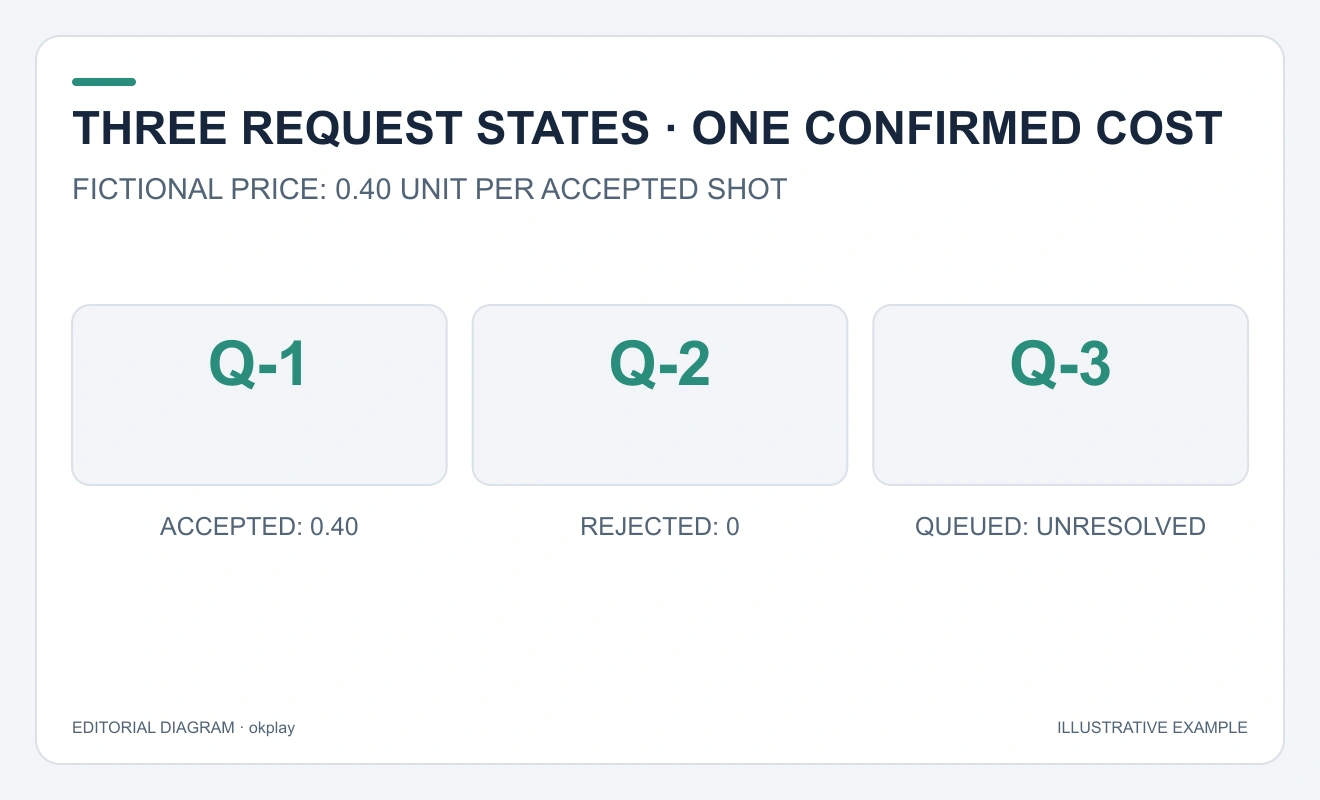
The confirmed accepted cost is 0.40. Three requests do not prove a 1.20 cost. The unresolved request should remain in a pending list; treating it as zero forever would be as unsupported as treating it as accepted immediately.
Update a request rather than inventing another
If Q-3 later becomes accepted at 0.40, the confirmed total becomes 0.80. The earlier queued row and its later acceptance describe one request state change, not two shots. Retain the request identity and acceptance time.
The British time-critical-event reference discusses communication timing in its own regulated scope. It does not confirm how a particular fishing product handles its input queue.
What releasing a control does not prove
A release timestamp alone cannot tell whether an earlier queued request was accepted, canceled or still pending. Use the accepted transaction log and the product’s input rules. Do not keep firing merely to diagnose a mismatch.
Separate a confirmed total from a conditional bound
If Q-3 can be accepted at most once, at the same fixed price of 0.40, and no other requests exist, the eventual accepted total is either 0.40 or 0.80. This is a bound under those explicit assumptions, not a confirmed cost of 0.80. A mode change, repeat-fire rule or additional request would require a different bound.
Two acknowledgements can describe one accepted request
Suppose Q-3 later appears twice with the same accepted transaction ID because the history was fetched again. Its charge still contributes once. If the two entries have distinct financial identities, do not delete one solely because their amounts and timestamps look similar; first determine whether one is a duplicate display or a separate charge. Keep request identity and financial transaction identity as distinct fields.
Cancellation before acceptance differs from reversal afterward
If Q-3 is canceled before any debit, confirmed spending remains 0.40. If it is first accepted and debited, the accepted cost becomes 0.80; a later linked reversal of 0.40 then leaves a net debit of 0.40. Those two histories have the same net effect but different accepted-event counts. The reversal is a return of cost, not a game award.
Use a balance boundary to locate the mismatch
With an opening balance of 10 and no awards or other movements, one accepted charge gives 9.60. Two give 9.20; the stated reversal restores 9.60. If the account differs, preserve the unexpected entry and ask for its identifier and amount type. A successful animation, a released button or a fast network response cannot replace the transaction evidence.