
Big Bass Hold & Spinner: what the 10,000x cap and 96.07% RTP mean in pesos
Published — UTC

Big Bass – Hold & Spinner has an official RTP of 96.07% on Pragmatic Play’s game page. The demo’s game-information data adds a 10,000x maximum round win and a reported frequency for that result. In pesos the cap looks large, but the chance of reaching it in a typical session is small. The figures below come from those published numbers, and each step is labelled as either reported or calculated.
What the official page confirms
The Pragmatic Play game page for Big Bass – Hold & Spinner lists a 5×3 reel layout and an RTP of 96.07%. It describes two bonus routes. Three coins in the base game add a bonus in which coins stay in place and their values are added to later wins. When coins appear on the reels, the page describes four respin chances. Collecting Wild symbols during free spins retriggers the round and raises a multiplier step by step. The page does not print a maximum win, so the 10,000x figure below comes from the demo’s game data, not from the page.
Reading the demo game-information fields
We checked the game-initialisation data of the official demo, read on 2026-10-15. These are the fields that matter for money arithmetic:
| Field | Value | How we read it |
|---|---|---|
| RTP, regular | 96.07% | Matches the official page. A long-run average return. |
| RTP, ante | 96.09% | Second mode in the demo data. Not shown on the page we read. |
| Max round win (max_rnd_win) | 10,000 | Largest round win as a multiple of total bet. |
| Max-win frequency (max_rnd_hr) | 2,750,653 | Reported as 1 in this many rounds. We did not measure it. |
| Alternate cap (max_rnd_win_a) | 6,666 | Lower cap in the second mode. We read it as the ante mode, which we could not confirm. |
| Alternate frequency (max_rnd_hr_a) | 1,563,966 | Reported frequency for the alternate cap. Same caveat. |
The cap in pesos
A cap is a multiple of total bet, so the peso figure moves with the stake. Our calculation for three common total bets:
| Total bet | Max round win (10,000x) | Alternate cap (6,666x) |
|---|---|---|
| ₱20 | ₱200,000 | ₱133,320 |
| ₱50 | ₱500,000 | ₱333,300 |
| ₱100 | ₱1,000,000 | ₱666,600 |
These are ceilings, not expectations. An RTP of 96.07% says nothing about how often one round reaches the cap.
How often the cap shows up
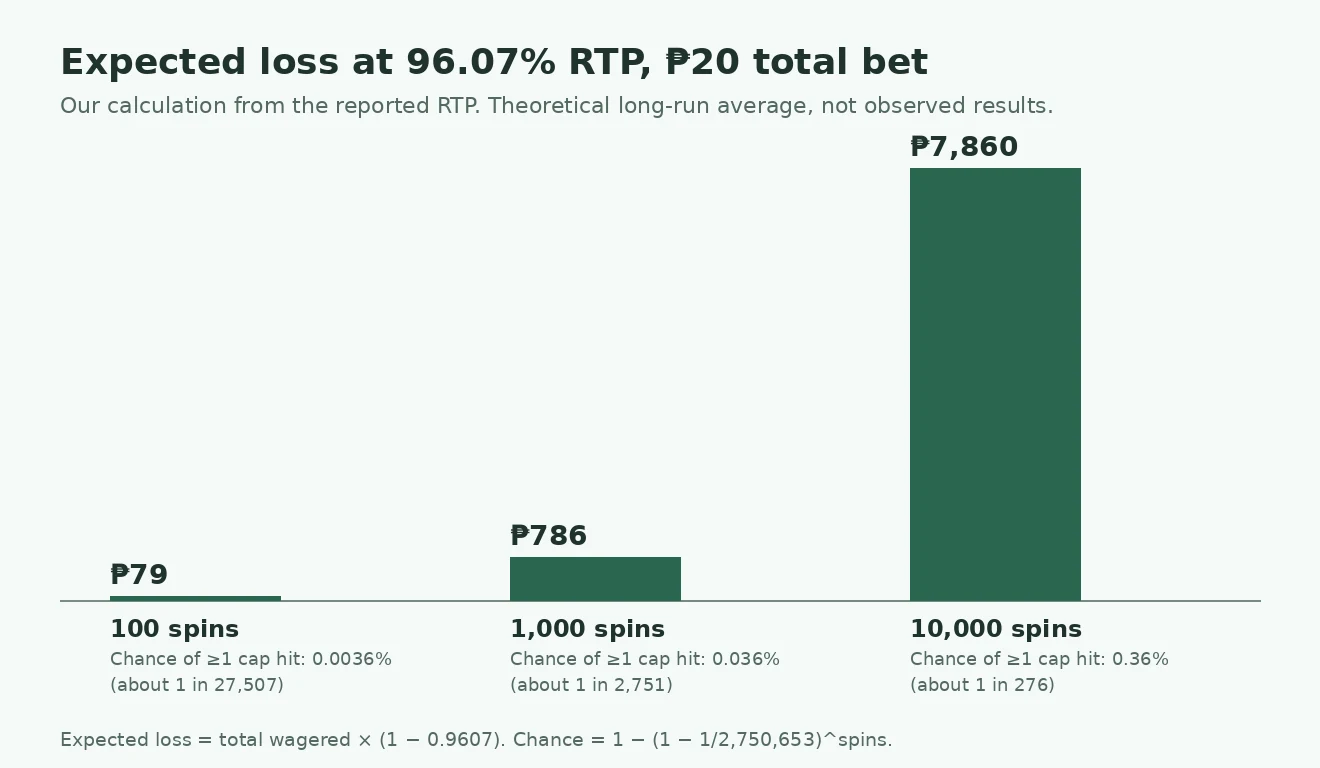
If each round is independent and the reported frequency is right, the chance of at least one maximum-win round in n spins is 1 − (1 − 1/2,750,653)n. Our calculation:
| Spins | Chance of at least one cap hit | Roughly |
|---|---|---|
| 100 | 0.0036% | 1 in 27,507 |
| 1,000 | 0.036% | 1 in 2,751 |
| 10,000 | 0.36% | 1 in 276 |
Two limits apply. The frequency is a demo field we have not confirmed against a second official document. The formula also assumes rounds are independent, which is the model a per-round frequency implies. Real sessions can be shorter or longer than these counts, and most will never approach the cap.
Expected return is a long-run average
At 96.07% RTP the theoretical edge is 3.93% of everything wagered. Our calculation for two session sizes at a ₱20 total bet:
| Spins | Total wagered | Expected return | Expected loss |
|---|---|---|---|
| 1,000 | ₱20,000 | ₱19,214 | ₱786 |
| 10,000 | ₱200,000 | ₱192,140 | ₱7,860 |
The spread around these averages is wide. A few large rounds carry most of the variance, so the same 1,000 spins can finish well above or below ₱19,214. The expected loss describes a very large number of players over the long run. It is not a forecast of your own session.
What this article does not show
- We did not run a demo session for this article, so no observed results are reported.
- The Hold & Spin and free-spin frequencies are not separate fields in the data we read, so we do not calculate them.
- The alternate-mode figures are labelled as read, not confirmed by the publisher.
Before you use these numbers
Check the total bet and the mode shown in the game before you compare any figure, because a peso example is only meaningful when the stake is clear. Treat the cap as a ceiling and the RTP as a long-run average. Play only with money you can afford to lose, and use the game’s own limit and history tools where they exist.