
Changed firing settings? Divide the shot log before taking the total cost
When the value of each shot changes, all shots cannot be multiplied by the last setting. Use our own three-part example to see the correct cost, the separate rewards and the net change in balance.

Total cost = sum of each shot count × the cost that exists in that part. The weapon label, effect size and current setting are insufficient records of previous charges. A confirmed count and unit is required for each segment if the setting changes mid-session.
Before counting, know what a shot is called
In this article, the shot is a confirmed charged action in the fictitious ledger. It’s not every spark, explosion, target hit or frame in the animation. If the actual game uses a different definition, the count must be changed according to its rules and record.
Before applying a shot ledger to underwater artwork, establish whether it is a fish arcade or fish-themed slot.
There is a concrete reason to separate the firing and feature display. In JILI’s official Royal Fishing overview, describes that shooting accumulates energy that can lead to a full-screen attack. That’s a feature description; it does not determine the price per shot in any operator account. We do not use the size of the full-screen effect to predict the number of charges.
The prices and rewards in the next worksheet are own fabricated assumptions, not Royal Fishing rates and not okplay live configuration. No bonus purchases, free ammunition, refunds, fees or pending charges are assumed. All amounts are credits in the same unit.
Own ledger: 40 shots with three different prices
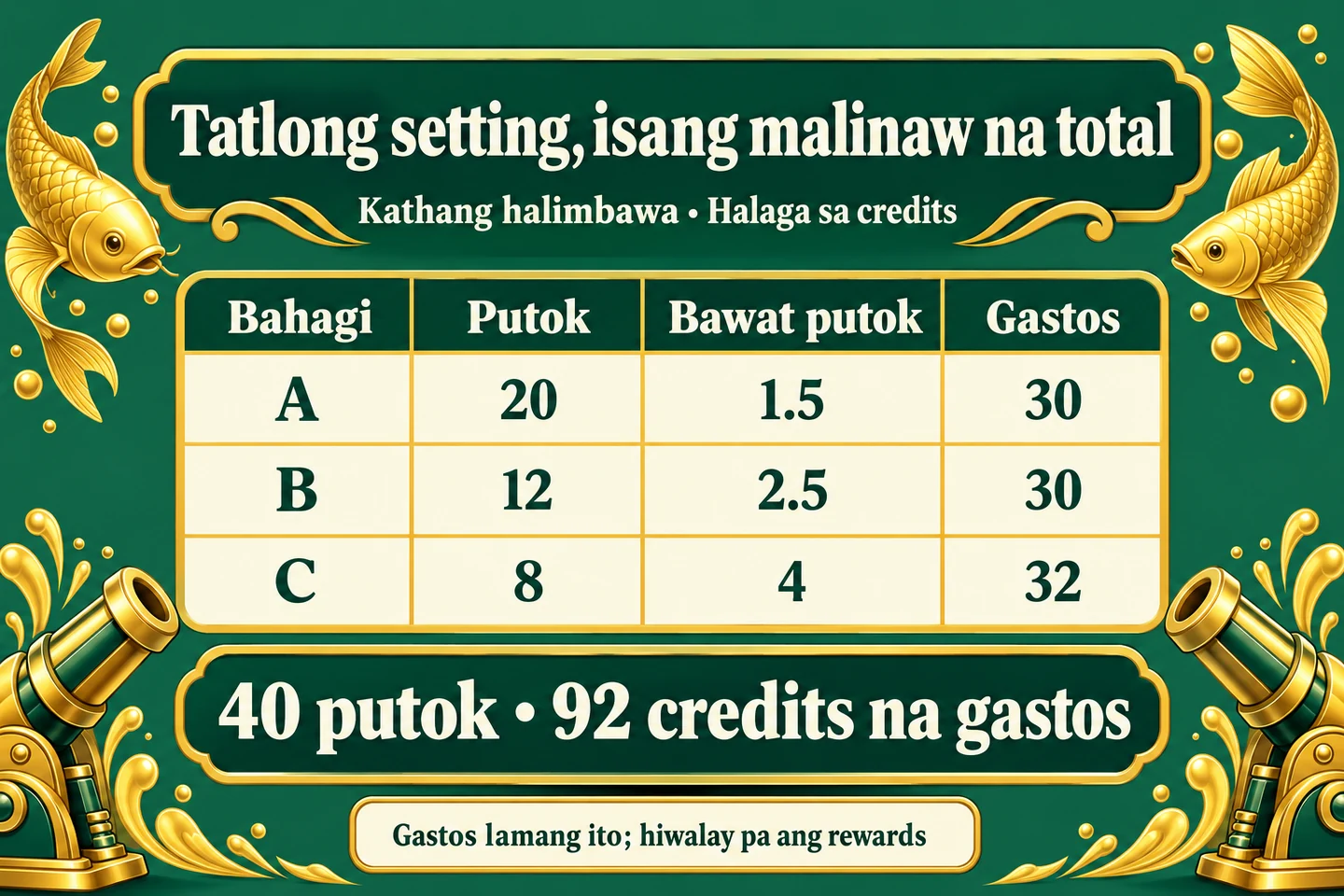
Assume it is clear from the record when the setting was changed. In the first part, there are 20 charged shots of 1.5 credits each. 12 followed at 2.5 each. In the last part, there are 8 of 4 each. Put each change in its own row so that the new price is not applied to the old actions.
| Part | Number of shots | Cost per shot | Subtotal |
|---|---|---|---|
| A: first setting | 20 | 1.5 credits | 20×1.5 = 30 credits |
| B: second setting | 12 | 2.5 credits | 12×2.5 = 30 credits |
| C: final setting | 8 | 4 credits | 8×4 = 32 credits |
| Total | 40 | Not a single fixed cost | 30+30+32 = 92 credits |
The total stake in the model is 92 credits. It is not profit or loss. We also don’t need to know how many fish appeared or how many visual hits were seen to get this sum, as long as the confirmed charge log assumed is complete and correct.
Two shortcuts that give the wrong total
If 4 credits are visible on the screen after the session and multiply that by all 40 shots, 160 will appear. This is 68 credits extra because the last price of the previous 32 actions was used. If the initial cost of 1.5 was used at all, 60 would come out—32 credits short.
Can be calculated weighted average cost which is 92÷40=2.3 credits per charged shot in the entire model. But this does not mean that there is an actual 2.3 setting selected. That’s just a summary of the three segments. The simple average of the three prices, (1.5+2.5+4)÷3, is also not a correct shortcut because the shot counts are not consistent.
The same goes for the “level” label. “level 2” does not automatically equal 2 credits. Mapping from setting to actual charged amount is required. Without the mapping, the cost calculation using the weapon name alone will not prove correct.
Enter the confirmed rewards in a separate ledger
Suppose there are three confirmed credits from the rewards: 15, 24 and 10. The total credited rewards is 49. Since the 92 stakes have been debited separately, the net change in the model is 49−92 = −43 credits. The profit is not +49.
If the opening balance is 200 credits and there is no other movement, the ending balance is 200−92+49=157. Same check 157−200=−43. When the two methods don’t match, look for the missing row, duplicate entry or other balance movement instead of trying to match the numbers.
Example of a separate branch: if there is an additional deposit of 30 credits in the same period, the ending balance will be 187. That was higher than 157, but the gaming net of −43 was unchanged. The 30 is external funding, not a reward. The withdrawal, fee, reversal and pending items must also be separated if there are any in the actual record.
A good animation or disappearing target is not a reward entry on the worksheet. Confirmed amount and matching identifier are required. If there is an event that has not been settled, put it on the pending list first; do not increase the confirmed total with a guess.
The unit must be the same before subtracting
If there is a currency conversion, record the declared rate and any fees. Just as an arithmetic example, assume that 1 credit = 0.20 currency unit, there is no fee and the rate is fixed. The 92-credit cost is 18.40 currency units; the 49-credit rewards are 9.80; and the −43-credit net is −8.60. The same computation is 9.80−18.40=−8.60.
92 credits cannot be deducted from 9.80 currency units without conversion. Nor should a rate be borrowed from another room, screenshot or game. The 0.20 in the example is just a fictitious rate and no real currency is named.
There is a related information standard in UK Gambling Commission RTS 2A: clear units and total stake, including conversion to currency or credits, are needed to understand the financial commitment. Great Britain is the regulatory context of the source. It is used here as an example of clear transaction information, not as a Philippine legal rule or license claim for the site.
When history is missing, mark which ones are not yet known
A useful log has a session or event identifier, time, active setting, confirmed cost per action, confirmed action count, and separate reward entries. With each setting change, create a new segment. No need to try playing again to fill in the missing record.
If the duration is known but the confirmed shot count is not, saying that auto-fire is fast is insufficient to calculate an exact total. If there is a free-shot feature, clarify which shots have no additional charge and whether an initial purchase is required. If a new debit appears after reconnection, find its record and explanation before drawing a conclusion. Closing the screen does not automatically confirm or cancel charges.
In the sample inquiry, it can be said: “There are 40 confirmed actions in three cost settings. My subtotals are 30, 30 and 32 credits. Can the 92-credit total be matched with the session record and determine if there is a separate fee or reversal?” Do not include password, OTP or payment credentials in the inquiry.
Go back to the fishing hub for context, the explanation of weapon level and session total, and the checklist of cost details. Naa guide library the related reading; with a general overview on okplay homepage. For correction about the article, use the Contact.
The ledger, conversion and images are their own teaching examples. No fishing session, operator account, current rate or actual capture probability is tested or verified here.