
Three-digit position matches: exactly two is different from all three
Matching two positions in a three-digit result does not match the whole sequence. It describes a different event. A figure for partial position matches cannot be presented as the chance of the exact three-digit result.
The okplay lottery section explains why matching order matters. Here we count the complete position-match distribution for one fictional digit model. It is not a PCSO prize table or a claim about a real draw mechanism.
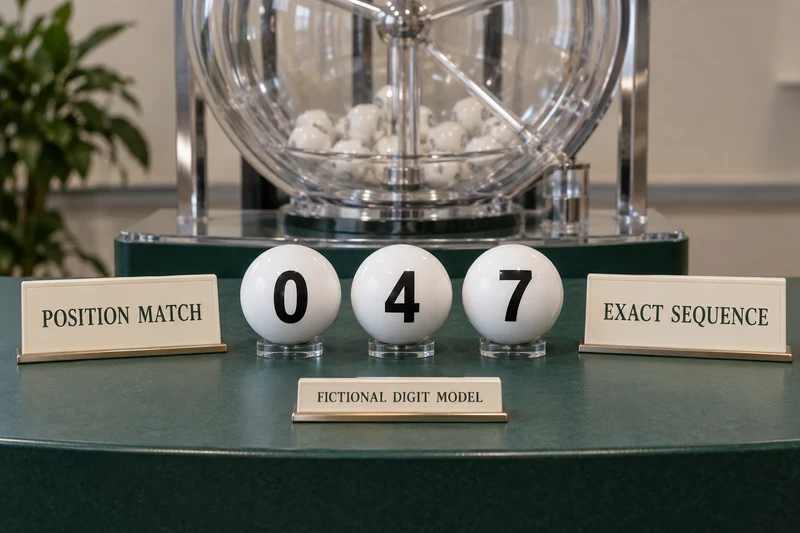
Keep three positions, including a leading zero
Our model allows each of three positions to contain any digit from 0 through 9, with repetition allowed. The first digit is kept even when it is zero. There are 10 × 10 × 10 = 1,000 ordered sequences, from 000 through 999.
Choose the teaching target 047. A position match compares the first result digit with 0, the second with 4 and the third with 7. The result 047 matches all three; 048 matches the first two; 407 matches only the third. Even though 407 contains the same three digits as the target, it does not preserve their positions.
Changing 047 to the numeric value 47 would remove a position from the record. Keep it as a three-character sequence when comparing or exporting it. A display format is part of this example’s definition, not an optional decoration.
Count exactly two matching positions
First choose which position differs. There are three choices. That position can contain any of nine digits other than its target digit, while the other two are fixed. The count is therefore 3 × 9 = 27.
For the group with the third position different, the possible results are 040, 041, 042, 043, 044, 045, 046, 048 and 049. Notice that 047 is excluded: it matches all three, so including it would violate the word “exactly”. The two other groups differ in the first or second position.
| Matching positions | Counting method | Sequences |
|---|---|---|
| Exactly 0 | 9 × 9 × 9 | 729 |
| Exactly 1 | 3 choices of matched position × 9 × 9 | 243 |
| Exactly 2 | 3 choices of different position × 9 | 27 |
| Exactly 3 | Only the target 047 | 1 |
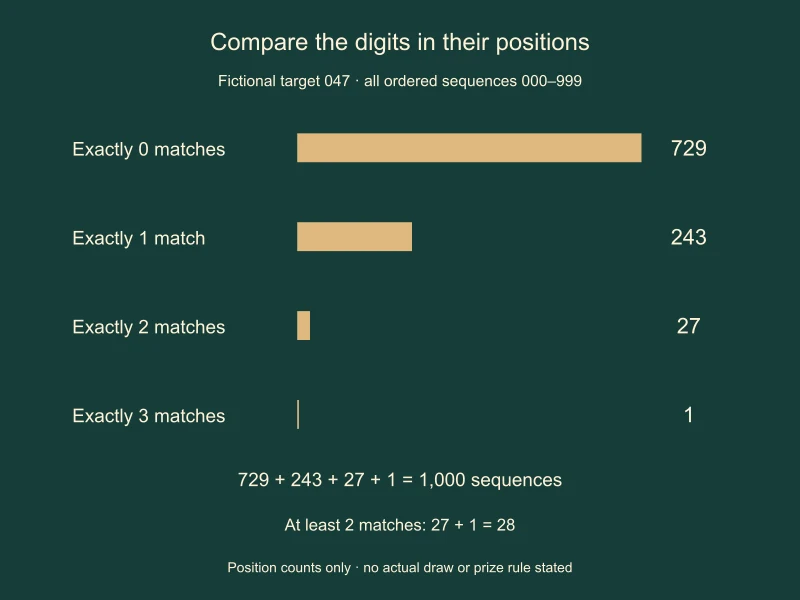
“At least” combines several disjoint categories
At least two matching positions includes the 27 exactly-two sequences and the one exact target, giving 28 sequences. At least one includes 243 + 27 + 1 = 271. Those totals are different from both “exactly two” and “all three”.
The four table categories do not overlap. Their counts add to 729 + 243 + 27 + 1 = 1,000, so every sequence is accounted for once. We also enumerated all 1,000 strings and compared each position directly; that independent check reproduced all four counts.
A repeated-digit target does not change this position count
Repeat the same calculation for target 000. Each position still has one matching value and nine different values. The distribution remains 729, 243, 27 and 1.
That does not mean order-independent permutations behave the same way. The target 047 has six distinct rearrangements; 000 has only one. Permutations of values and matches at fixed positions are different questions. Sorting the result would change the question being checked.
State the assumptions before turning counts into percentages
If all 1,000 ordered sequences are equally likely, the model probability for exactly two position matches is 27/1,000, or 2.7%. The exact target is 1/1,000, or 0.1%. These percentages require the stated uniform independent-digit model; the enumeration alone does not audit a real lottery.
OpenStax’s binomial distribution chapter describes counting successes across a fixed number of independent trials with the same success probability. Our illustrative position comparison uses three trials and a matching probability of 1/10 per position. The lottery wording and complete enumeration are our own example.
The existing single-number versus whole-set guide makes a related distinction for an unordered six-number model. Do not carry its denominator into this ordered-digit model.
Read the product rule separately
A partial match count is not a paid prize unless the actual product defines it as one. Identify the product, draw or session, required order and eligible category before interpreting a record. This teaching model states no payout, ticket price, availability or current result.
Counts checked on 10 October 2026. All target strings are fictional examples, not predictions or recommended selections. No ticket purchase, account transaction or real draw test was performed.